Over 60% of Michigan voters already rejected a Betsy DeVos voucher scheme. Now, Trump’s trying to bring it back—and Michiganders are telling Whitmer to make sure he keeps his hands off the Mitten’s schools.
“Public funds for public schools—no vouchers here!”
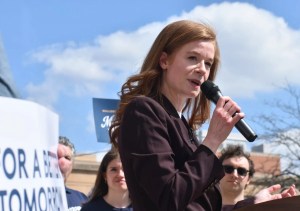
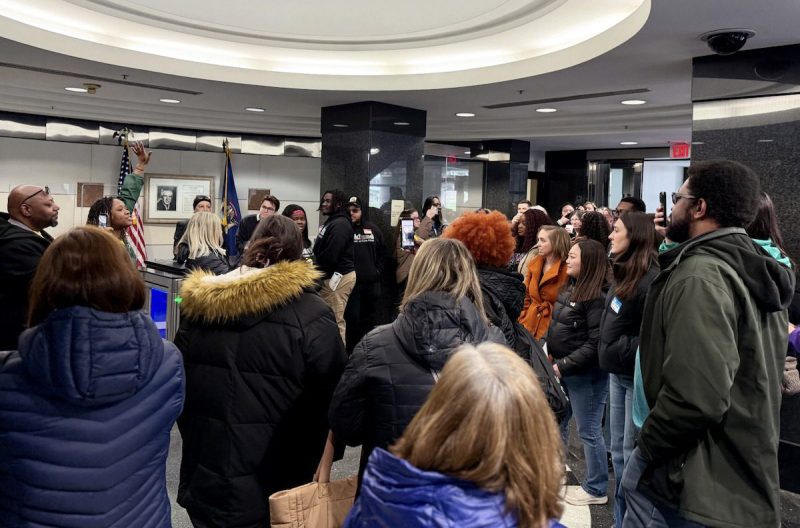
Those chants could be heard throughout the halls of the George W. Romney Building in Lansing last week, as a group of over 50 local educators, school board members, parents, students, and members of several education advocacy organizations packed in its lobby.
Standing shoulder to shoulder, the group demanded that Gov. Gretchen Whitmer say no to the Educational Choice for Children Act (ECCA), which was part of the Republican-backed reconciliation bill signed by President Trump last summer, and is part of his current administration’s larger plan to remake public education nationwide.
What is the ECCA?
The ECCA is an opt-in program that invites state governments to join a national voucher-style scheme administered through the federal tax code, shifting public money toward private and religious schools and away from state and local public-school budgets.
Although it doesn’t directly fund school vouchers, the ECCA creates a large dollar-for-dollar federal income tax credit for donations to certain “scholarship-granting organizations.” These organizations then hand out K-12 “scholarships” that function like private school vouchers.
Wealthy taxpayers can dramatically reduce or zero out their federal tax bills by routing would-be tax payments into these voucher funds instead.
Read more: Education vouchers 101: What are they and how could they impact Michigan’s K-12 students?
“One of the reasons that MEJC wants to meet with the governor is because we know that Michiganders don’t want this scheme,” said Rachelle Crowe-Hercher, director of the Michigan Education Justice Coalition (MEJC), adding that the ECCA is modeled on a program that Trump’s former education secretary, Betsy DeVos, championed but failed to pass in Michigan in 2022, and would further divert resources from public schools across Michigan, which are already facing a $4.5 billion funding gap.
“ECCA was modeled after what Betsy DeVos was collecting signatures for here in 2022 and 2023, trying to sell them as these magical scholarships for students, and over 60% of Michiganders rejected it the last time this came for us. We know the support for this ECCA scheme is not there, and we don’t want it here,” said Crowe-Hercher.
WATCH: Trump’s vouchers revive DeVos’ rejected plans for Michigan’s schools
Analyses show the program would generate about $126 billion in donations over just 10 years, but cost public budgets more than $134 million in federal revenue, creating a net loss for the public, supercharging school privatization, and worsening public services.
Meanwhile, an estimated $10.5 billion would be a literal profit for the wealthy donors through capital-gains tax avoidance and over-generous credits.
Michiganders say they want Whitmer to protect public schools
Throughout the day, members of the group spoke to other state lawmakers about how policies like ECCA would impact Michigan students living in rural areas where private school options are scarce or nonexistent. There, vouchers offer no real “school choice,” only funding cuts that further weaken the public schools serving as the heart of those communities.
Public schools are also legally required to educate every student, including students with disabilities, English learners, and those most at risk. They’re held to strict standards for transparency and accountability—unlike private schools, which can handpick students and are not subject to the same public oversight, testing requirements, or accountability standards.
While they were unable to meet with Whitmer, the group did speak with the governor’s education liaison to schedule a meeting to discuss the ECCA and other public school funding issues.
Imani Foster, an organizer with 482 Forward, a Detroit-based coalition that helps local students prepare for the future, said she hopes Whitmer will keep her promise to fund Michigan’s public schools and join other states that have opted not to join the ECCA.
“I know what my state wants, and it’s not [the ECCA]. We were really just asking our governor to be bold and take the first step alongside two other states that have already said no to this,” Foster said.
In the meantime, Crowe-Hercher says the group will continue organizing to urge state lawmakers to prioritize public schools in the next state budget. They also encourage folks to add their names to the growing list of Michiganders signing an online petition telling Whitmer not to opt in to the ECCA.
“This is not a lifeline for struggling families. It is a subsidy for people who were never in public schools to begin with, paid for by everyone else,” said Crowe-Hercher, referencing data showing that 75% to nearly 90% of vouchers are used by students who were already attending, or already planning to attend, private school without state aid.
“We have seen where that road leads. Gov.Whitmer has a chance to send a clear signal that Michigan will not go down it.”
For updates and to learn more about the work Michiganders are doing to protect public school students statewide, find resources here.
Read more: Michiganders say Trump’s voucher push puts Michigan public school funding at risk