BY BEN SOLIS, MICHIGAN ADVANCE
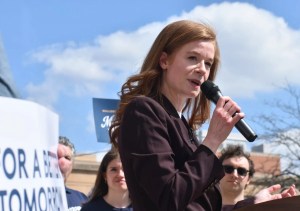
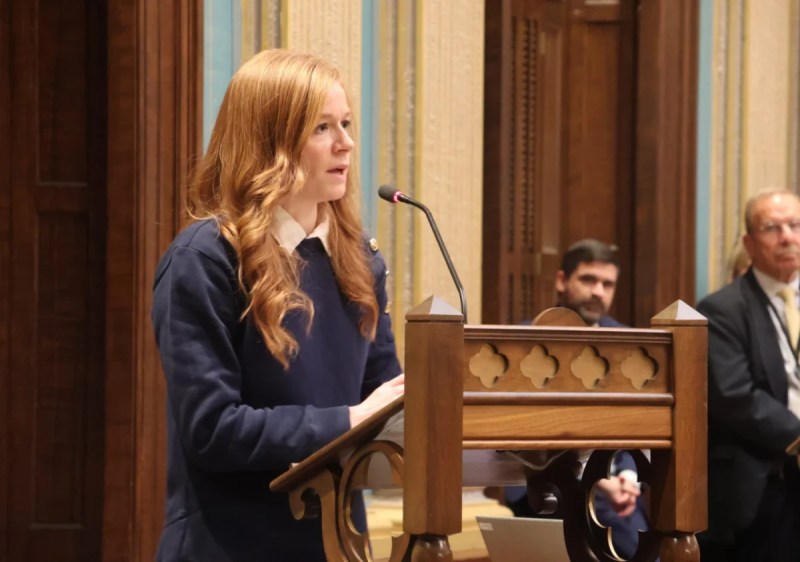
MICHIGAN—Data centers in Michigan don’t have to be developments fraught with transparency and environmental concerns, US Senate candidate Mallory McMorrow said Thursday as she released a policy plan to better regulate hyperscale digital infrastructure.
A wave of more than 15 new data center proposals have come into communities across the state, including a 1.4-gigawatt facility planned by Oracle and OpenAI, which is being developed by Related Digital. That makes Michigan fertile ground for opposition against data centers, which has attracted naysayers from wide swaths of the state’s electorate.
The seven-point plan released by McMorrow, a state senator from Royal Oak, focuses on green energy as the primary source for data center developments, tax revenue and union labor requirements, and the prohibition of secret agreements between technology companies and local governments.
“When it comes to data centers, Michigan has an opportunity to show the country how to do it right,” McMorrow said in a statement released Thursday. “That means data center companies, not Michigan families, will pay for their own energy, grid upgrades for the benefit of all ratepayers; pay their fair share in taxes to fund our schools, roads, and communities; and pay our workers by creating good-paying union jobs.”
McMorrow went on to say that “Michigan revolutionized auto manufacturing to be safer, cleaner, and union-built. We can do the same for data centers—and show the rest of the country how it’s done.”
At the top of her plan is making sure data center developers pay their own way so that ratepayers aren’t affected by data center-driven utility rate hikes. That would include new ratepayer protections from new costs associated with data center growth and expansion, as well as the upfront costs for power generation and transmission lines.
Developers would bear 100% of the cost for infrastructure, generation and transmission costs needed to serve their facilities. McMorrow would also require that data centers invest in grid infrastructure improvements, which could help bring down rates and increase high-speed internet to rural communities and low-income residents. Requiring water and energy infrastructure improvements is also found in McMorrow’s plan.
Union labor would be a must under McMorrow’s framework, requiring developers to hire local unionized workers and provide them with a living wage.
Non-disclosure agreements should be banned, McMorrow said, so tech companies and local governments can’t hide the ball, so to speak, on the impacts communities might face as a result of a data center springing up in their neighborhoods or countryside. Her plan would also require monthly data publishing on water and energy usage and economic impact projections. Annual independent audits of data center claims, paid for by fees collected from developers and artificial intelligence companies, round out McMorrow’s regulatory scheme for the emerging tech centers.
A separate community reinvestment fund would be created under the framework, with required annual contributions from data centers and tech companies—money that could be used for workforce training, infrastructure upgrades, green space projects and other community needs.
American AI data center construction or operation in adversarial nations, like China or Iran, would be banned, McMorrow said. She would also go after President Donald Trump’s authorization for Nvidia to sell its AI chips to those nations, with national security officials also handling the permitting if companies want to build outside “trusted ally nations.”
McMorrow’s campaign addresses conflict of interest concerns
McMorrow said her plan would also call on new data centers to source at least 90% of their projected electricity needs from renewable energy.
The mention is an acknowledgement of the potential ecological risks associated with data centers, including high demands on grid-produced electricity and groundwater water resources that could be depleted to cool key components. McMorrow’s plan would address the larger concern over where energy supplies would come from to power AI data centers.
The candidate, however, came close to having a unique potential conflict of interest with that aspect of her plan: McMorrow’s husband, Ray Wert, a strategic and corporate communications expert, previously worked for a company that is hoping to replace the same types of backup generators predominantly used by AI data centers with portable, nuclear microreactors.
The company that Wert worked for is Radiant Nuclear, which is currently developing and hoping to soon deploy its Kaleidos nuclear microreactor at scale.
Many AI data centers currently use diesel generators as a key secondary source of backup power in the event of an electricity shortage or a grid failure. Radiant’s Kaleidos microreactor nuclear generator is betting big on data centers moving away from those generators in place of what it bills as a more ecological friendly option. Radiant, in its promotional materials and product pitches, places a large emphasis on the fact that diesel generators produce large amounts of CO2 pollution and also carcinogenic exhaust.
In August 2024, Equinix Inc., which hails itself as the world’s largest digital infrastructure company, announced that it would work with several “leading energy companies that are developing innovative approaches to generating reliable and sustainable electricity to support the needs of Equinix data centers worldwide.”
Radiant Nuclear and its Kaleidos technology is listed as one of those companies in a news release from Aug. 14, 2025.
A message seeking comment from the company about additional plans for AI data center deployment was not returned.
When asked about the connection between Wert and Radiant, which would ultimately have an advantage if it tried to enter Michgian’s data center market and McMorrow was the state’s new junior US senator, a campaign spokesperson said that Wert was no longer with the company as of early March.
Wert asserted that he did so to spend more time and take care of their daughter while McMorrow was on the campaign trail.
His LinkedIn account, as well as his X social media page, still listed him as being employed with the company as of Friday morning. The campaign said that was an oversight and his pages have not been updated.
A second message seeking comment from Radiant about Wert’s employment with the company was not returned, either.
How does McMorrow’s plan stack up against the other candidates?
McMorrow is not the only candidate in the race to release a data center attack plan.
Democratic US Senate candidate Abdul El-Sayed released a data center policy “terms of engagement,” which calls for zero rate hikes, community transparency and other guarantees.
While El-Sayed’s and McMorrow’s disparate plans have a lot of overlap, McMorrow’s appears to go into greater detail. El-Sayed’s plan does not mention a community reinvestment fund, nor does it specifically call for union-only labor on data center projects or bans on vital AI chips from being sold to unallied nations.
US Rep. Haley Stevens (D-Birmingham), who is also in the Senate race, has not yet developed or released an AI battle plan, but did point to her actions in Congress regarding AI tech and data centers.
“When it comes to data centers and AI infrastructure, my top priority is making sure costs don’t go up for Michigan families and that we are protecting good-paying union jobs,” said in a statement to the Advance. “We cannot allow utility companies like DTE to pass new costs onto consumers while these projects move forward, and I will continue to hold them accountable.”
Stevens went on to say that she wants “to see good-paying, union jobs come to Michigan, and we need to develop a clear, responsible policy framework to ensure these technologies are developed safely and securely.”
More specifically, Stevens’ campaign noted that she has introduced the Stop Unfair Electricity Prices Act, which would strip federal funding away from investor-owned utilities that raise their rates for customers within a year of the last price hike. Under the legislation’s three-year timeline, in year one, any utility that sought an additional rate hike would lose funding from the U.S. Department of Energy. In years two and three, the utility would lose federal funding if it raised rates and did not cut the pay of the five highest-paid employees by double the percentage of the rate increase.
The leading Republican candidate in the race, former US Rep. Mike Rogers of White Lake, has not released a data center policy plan, but has been vocal about communities being held harmless for energy rate spikes that come along with new developments, and don’t cause rolling blackouts, something he shares with his Democratic opponents in the race—which highlights the overlap on the issue for both parties.
In contrast to that, however, Rogers has also been eager to ease the process of seeking permits for new AI facilities.
“We have to make Michigan competitive for new AI-supported jobs and investments that grow our state, while setting a responsible framework for safety and data privacy,” Rogers said in a statement to the Advance. “We need to make sure data centers pay for all their own power usage so that Michiganders aren’t footing the bill in higher rates.”
READ MORE: Abdul El-Sayed releases plan to rein in data center expansion in Michigan
This coverage was republished from Michigan Advance pursuant to a Creative Commons license.