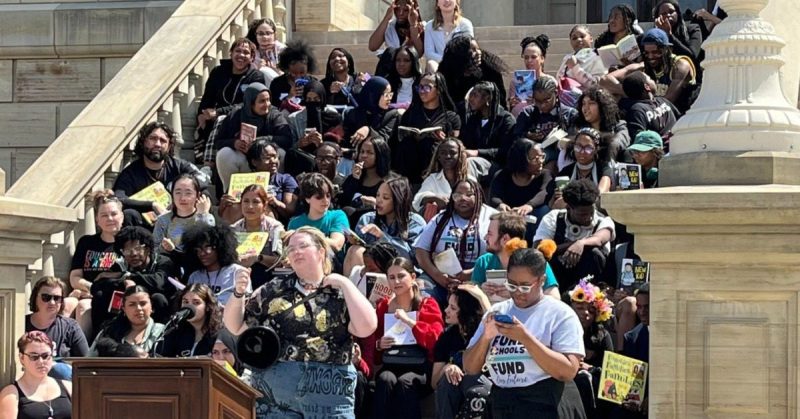
Students from across the Great Lakes State, alongside educators and advocates, recently gathered in Lansing to fight for a future where every Michigander receives a quality education.
At least 50 students from various school districts gathered on the steps of the Michigan Capitol this week as part of an advocacy day held by the Michigan Education Justice Coalition (MEJC), a statewide network committed to advocating for equitable public education policies and funding to create safe and healthy learning environments for Michigan students.
During the April 29 rally, students from across the Great Lakes State used the opportunity to share their stories and explain how attacks on public education are impacting them and their classmates.
Restricting reading
Demetrius Davis, a student from the Upper Peninsula, expressed how banning books limits students’ ability to learn about history or the perspective of others whose history isn’t popularized, particularly people of color.
“The banning of books and Black history in our schools shall not be tolerated. We, the people, reject the erasure of our stories and the whitewashing of our curriculum,” said Davis.
Books that touch on racism, sexuality, gender, and history are being targeted in particular. In the 2023-2024 school year, PEN America counted more than 10,000 book bans in public schools
This is particularly relevant in Michigan, especially as several school districts—including Dearborn, Portage, and Davison—continue to remove books with certain themes from their libraries.
“ They tell us that reading about slavery is a disgrace to our nation. We, the people, refuse to live in ignorance,” said Davis.
“ We stand here today to show them they will never ban us from learning. They cannot ban our stories. They can never hide the truth from us. It will always be found,” said Davis.
Mental health matters
The National Center for Education Statistics says inadequate funding is one of the most commonly identified barriers to providing effective mental health services in schools.
Without the funding, students like Christina Yarn of Saginaw worry about how it will affect her and her classmates who struggle with mental health.
“We need psychologists and more mental health resources in schools,” said Yarn. During the MEJC press conference, Yarn recited a poem she wrote about what it’s like for her and other students to navigate their anxiety, depression, and other emotions while at school.
The poem was inspired by Stephen Chbosky’s Perks of Being a Wallflower, which has been banned or challenged in schools across the US at least 85 times.
“My heart is aching. Nobody understands how bad I’m breaking…Teachers aren’t listening. Preachers have no thought behind their preaching. God is our only light, that’s why we stay putting up a fight,” Yarn recited.
Money moves
While Michigan Senate Democrats put forward a more than $1 billion funding increase for the state’s public schools on April 29, students are holding their breath as President Donald Trump reels back tens of millions of dollars in federal education funding that was supposed to go to dozens of Michigan school districts.
Related: Trump administration withdraws education funding for nearly 100,000 Michigan students
Several students at the MEJC press conference spoke about the importance of having well-funded schools.
“Money helps schools improve in big ways. With better funding, schools can upgrade their facilities—including libraries—and give students access to better books and learning resources,” explained Nabiha Chowdhury, a student from Detroit.
Chowdhury added that when schools have enough funding, they’re more likely to recruit and retain high-quality teachers, ultimately helping students build stronger relationships and learn more over time.
“Money gives schools the tools they need—and gives students access to the books, support, and opportunities they deserve,” said Chowdhury.
Imani Clark, who serves as the lead youth organizer for the MJEC, said that it has been inspiring to see students work together over the last few months to put together such an inspiring event.
“What started as a small, student-led action has grown into a big movement,” said Clark.
“We are powerful, and we have something to say.”