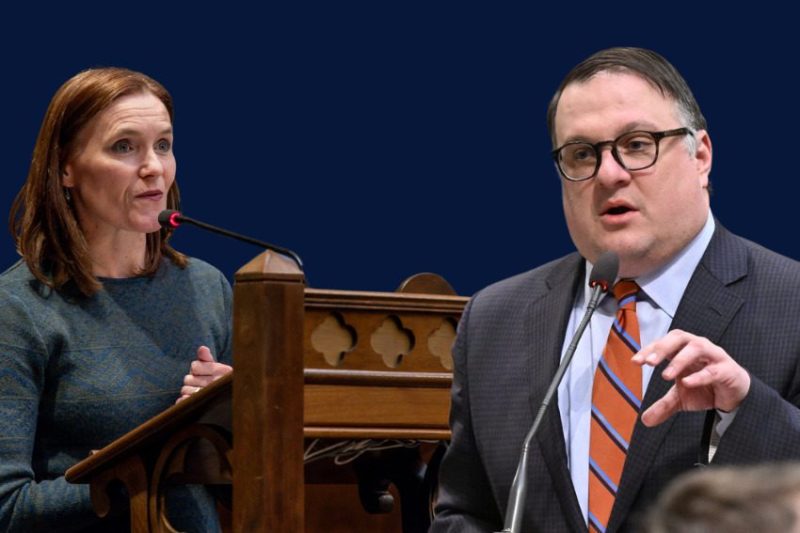
Senate Democrats authorized legal action against House Republicans for withholding nine bills passed last session— accusing them of violating Michigan’s Constitution by delaying the legislation from reaching the governor’s desk.
LANSING—Michigan Senate Democrats approved a resolution this week allowing state Senate Majority Leader Winnie Brinks (D-Grand Rapids) to take legal action against the Republican-led state House of Representatives for delaying previously approved legislation from becoming law.
The resolution, introduced Tuesday by Brinks, accuses Michigan House Speaker Matt Hall (R-Richland Township) and other Republicans of violating the state Constitution by refusing to forward nine previously passed bills to Gov. Gretchen Whitmer to be signed into state law.
It also calls on Hall to send those bills to the governor immediately—or face a lawsuit.
“At the bare minimum, Michigan residents deserve elected officials who are committed to fulfilling their constitutional duties—but Republican leadership in the House of Representatives has decided to start off the new legislative session with a blatant violation of our state constitution,” Brinks said in a statement Tuesday. “We are making it abundantly clear that we will not tolerate illegal, partisan games that undermine the legislative process.”
Disputed Bills
The nine bills in question were passed by the Democratic-led House last year and finalized during a marathon Senate session in December before lawmakers adjourned for the holidays.
But because none of the bills were forwarded to the governor’s desk to be signed into law, they’ve been stuck in a sort of legislative limbo—and the newly installed Republican majority in the state House, at least so far, has been reluctant to move the legislation forward.
The pending legislation includes:
- House Bills 4177, 4665, 4666, and 4667 of 2023,
- House Bills 4900, 4901, 5817, 5818, and 6058 of 2024.
They reportedly include measures that would:
- Increase funding for city-owned museums in Detroit
- Modify wage garnishment and bankruptcy laws.
- Increase public employer contributions to employees’ health insurance policies.
- Broaden eligibility for the State Police Retirement System to other jobs related to law enforcement—including state corrections and conservation officers.
Legal and Constitutional Debate
The resolution approved this week in the state Senate cites Article IV, Section 33 of the state Constitution, which mandates that “every bill passed by the legislature shall be presented to the governor before it becomes law.” While the Constitution sets no precise timeline or procedure for this, Senate Democrats argue that it is Hall’s constitutional duty to act without delay.
Hall, for his part, has defended the decision to delay the bills—telling reporters that they’re undergoing a legal review and there’s no big rush to shuttle the legislation over to Whitmer.
“We’re just trying to follow the Constitution and the law,” he told reporters this week.
The Senate resolution, however, argues that Hall has no authority to conduct such a review, as the bills were already passed and are now legally required to be sent to the governor’s office.
Senate Democrats have not set a timeline for any potential legal action. But Brinks has made it clear that Hall could avoid a potential lawsuit simply by sending the bills to Whitmer’s desk.
“I am prepared to take legal action if necessary to ensure that the constitution is followed,” she said. “Hall can avoid this completely by doing his job and sending these bills to the governor.”
READ MORE: Michigan Dems race to pass bills before Republicans take over House
Don’t miss Michigan’s biggest stories—follow The ‘Gander on X.